Is bandhej usually printed on black?
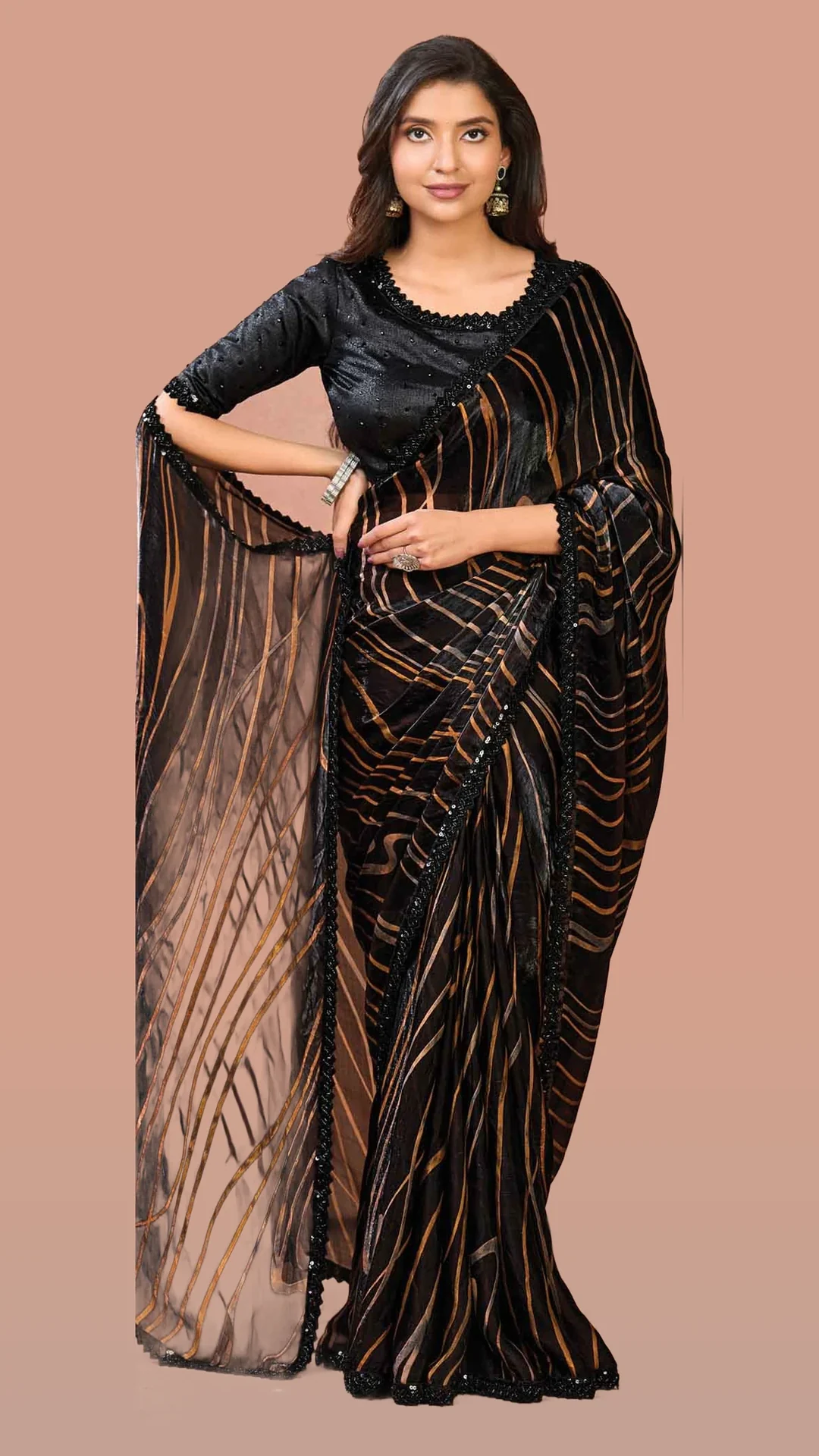
Rarely. Bandhej and bandhani are traditionally associated with saturated reds, yellows and greens, the colours the tie-resist dyeing tradition is built around. A black ground is an uncommon choice, which is part of what makes this saree distinct within the range.
Why does the work look brightest on this saree?
A black ground gives the maximum possible contrast against reflective work, so mirrors, stones, sequins and pearls all register at their strongest. The same work on a pale or mid-toned saree competes with the fabric colour and reads considerably softer from a distance.
Which metals work against a black ground?
Almost anything. Black is a neutral ground that does not clash with gold, silver, oxidised metal, pearl or coloured stones, which makes it the easiest saree in this group to accessorise. Given the existing mirror and stone work, one restrained piece usually reads better.
How does the two tone weave help on black?
Contrasting yarn colours in warp and weft stop the folds collapsing into an undifferentiated dark mass. Without that, a black saree can lose all definition in low light. The shot effect keeps shape and depth visible even where direct light does not reach.
Which work types are listed for this saree?
Dual sequins embroidery with pearl, stone and mirror handwork, which is the full work set for this family. Dual sequins vary the disc size, pearls add soft lustre, stones add hard sparkle, and mirrors carry the reflection across a room.
Can I return this?
Yes. Vpnam has a 7-day return window, and the full terms are in the Refund and Returns Policy. Contact us within 7 days of delivery if the item arrives damaged or defective, an item is missing, or a different product was sent, and keep the item, tags and original packaging unused while the claim is reviewed. Worn, washed, altered or tailored products cannot be returned.